
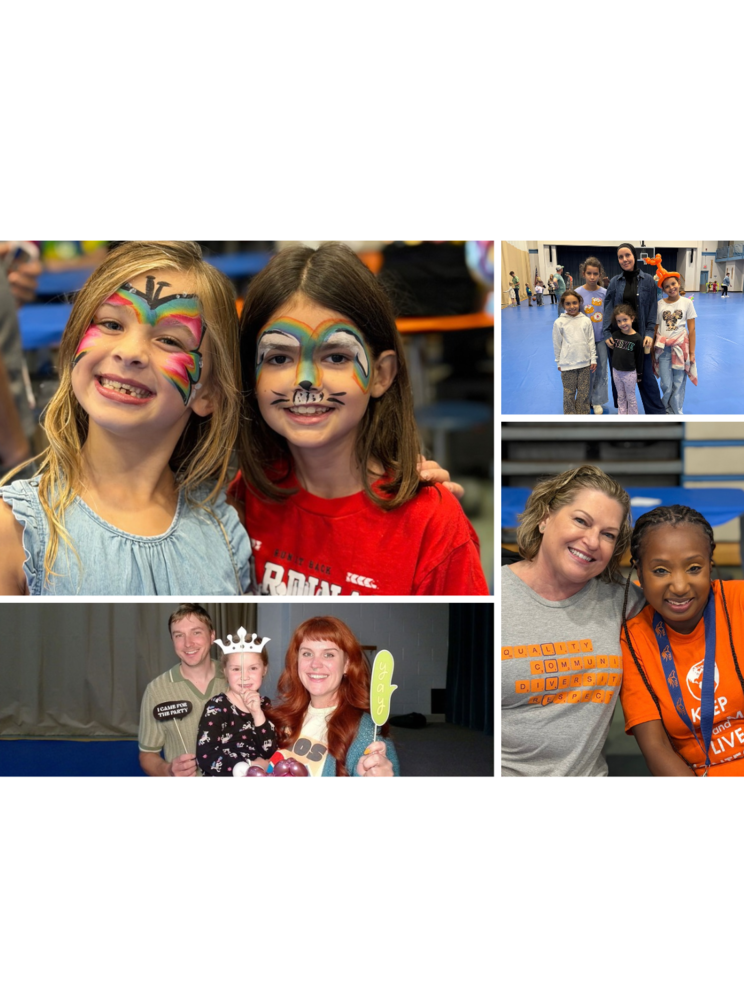
This past weekend, TMA hosted our first large community event of the school year—our annual Ice Cream Social and celebration of Dr. Maria Montessori’s birthday. Traditionally, we gather outside on the playground, but this year the weather had other plans. We moved everything indoors, filling our gym and library with children, parents, teachers, Board members, and friends.
As I looked around the gym and watched families laughing, talking, playing, and simply enjoying being together, I found myself thinking about something much bigger than an Ice Cream Social.
I was thinking about the culture of a school—and what it means to truly belong to one.
Finding TMA
I first walked through the doors of TMA in 1998. My daughter, Dana, was only about six months old, and I had recently moved back to South Bend from Bloomington. Montessori was still very much on my mind, and I wanted to learn more about the Montessori school in my community.
I still remember that first visit. There was something about the school that made me feel connected almost immediately.
I visited again in 1999, and in 2000, Dana began in the Toddler program. I could not have known then just how much those first visits would shape our lives. TMA would become Dana's school, my workplace, and, in many ways, a second home for both of us. Then, in 2007, my son, Cooper, was born, and before long, he began his own Montessori journey at TMA.
More than 25 years later, I still think about what I felt when I first walked through those doors. Why did I so badly want Dana to be part of this community? And why did I want to be part of it, too?
I think I understand it better now.
I wanted my daughter to grow up knowing that she belonged.
A Place Where Differences Are Celebrated
As a child, I did not always feel that sense of belonging myself.
I was serious about playing the violin from an early age, and I was dramatically taller than everyone else. I was nearly five feet tall at seven years old! Those things made me different—and when you are seven, different does not always feel particularly wonderful.
It can feel lonely.
Today, of course, I celebrate "different." I recognize how important it is for children to discover who they are and to become comfortable and confident in that person. But when I became a mother, I knew I wanted something for Dana that I had not always felt myself: I wanted her to embrace the things that made her unique, to be proud of who she was, and to know that she belonged.
I think that is part of what I recognized when I first visited TMA.
Montessori education respects the individual child. Children do not all have to learn in exactly the same way, develop on exactly the same timeline, or share the same interests and strengths. Each child is seen as an individual who is also an important member of a larger community.
That balance—individuality and community—is something very special.
Choosing a School Means Choosing a Community
When we look for a school for our children, we naturally focus on the child. We think about teachers, classrooms, academics, friendships, and whether our child will be happy and successful.
But we are also choosing a community for ourselves.
A child who attends TMA from Toddler through Junior High may spend twelve years here. Twelve years is a significant portion of a childhood—and of a family's life.
During those years, children form friendships. Parents form friendships. Families celebrate milestones together. They watch one another's children grow. They cheer at events, volunteer in classrooms, attend performances, talk in the parking lot, help one another through difficult seasons, and sometimes simply offer a listening ear when another parent needs one.
That is culture.
It is not something we can manufacture or write into a handbook. It develops through relationships and through hundreds of small moments when people feel welcomed, valued, and connected.
Community in Action
Our Ice Cream Social was one of those moments.
Moving the event indoors could easily have made for a chaotic afternoon. Instead, our community embraced the change.
Throughout the afternoon, children had their faces painted and watched a balloon artist create something just for them. Families used the portable photo booth, with and without props, to capture memories together. Children played Gaga Ball, kicked soccer balls, shot hoops, and tried out a new multi-hoop basketball game for our younger students.
Then our wonderful music and Junior High Humanities teacher, Mr. Sweeney, brought children, parents, and teachers together for a spirited game of musical chairs!
For families who needed a quieter space, our library offered puzzles and games.
Everywhere I looked, I saw people smiling, laughing, talking, playing, and connecting.
Members of our Board of Trustees and representatives from our Montessori Parent Association (MPA) were also there to welcome families. These volunteers give their time and talents to our school because they care deeply about this community. Events like this give families an opportunity to get to know one another and begin forming connections that extend far beyond a single afternoon.
And just a few days later, I had the opportunity to see our community at work in a very different way.
On Wednesday, September 23, our MPA hosted its monthly TMA Time Together and Teacher Task Team Up in the library. Families gathered to talk and connect while also helping teachers prepare classroom materials.
As a longtime Montessori classroom teacher, I know exactly how meaningful that help can be!
Montessori teachers create an enormous number of materials by hand. During my first five or six years as a Lower Elementary teacher, I spent countless hours coloring, cutting, copying, and laminating. I once spent approximately 40 hours creating my six-foot-long Timeline of Life—and then paid more than $110 to have it professionally laminated at Kinko's!
So, watching our families work together to cut, copy, laminate, and carefully prepare materials for our teachers was especially meaningful to me. They paid attention to every detail because they understood that what they were creating would eventually find its way into the hands of our students.
It may have looked like cutting and laminating.
But it was really community.
A Place to Belong
Culture is built in classrooms, but it is also built in gyms and libraries. It happens during an Ice Cream Social, while parents prepare classroom materials, during conversations in the hallway, and in those moments when one family reaches out to another.
It is built when children know they are valued for who they are.
It is built when parents know they have people they can turn to.
It is built when teachers feel supported.
And it is built when families understand that they are not simply attending a school—they are part of a community and helping to shape it.
More than 25 years ago, I walked through the doors of TMA as a young mother looking for a school for my daughter. I did not yet have the words to describe what I felt here. I simply knew that I wanted Dana to be part of it.
Looking around our gym this past weekend, I think I finally found the words.
I wanted her to have a place where she could become fully herself—and know that she belonged.
All these years later, that is still what I want for every child who walks through our doors—and for every family who walks through them alongside their child.
Because, in the end, a school is more than its classrooms, its curriculum, or even its teachers. A school is the people who choose to show up for one another.
That is the culture I felt when I first walked into TMA.
And it is the culture I hope every family who walks through our doors feels today.